Leave a comment

M*A*S*H Quiz

M*A*S*H is one of the best television series of all time and was one of the first shows to cross comedy with drama, mixing hilarious hi-jinx with the horrors of war.  The series lasted eleven years, eight more than the actual Korean War in which it was set, and most of those years it was at the top of the ratings.  In fact, the 2 1/2 hour finale held the record for over two decades as the highest rated televised event ever.  Additionally, it was a critical darling, racking up countless awards for its innovative storytelling, and is still shown on TV in syndication.  Take the following quiz and see how much you know about M*A*S*H:

Take the M*A*S*H Quiz!

After taking the quiz, scroll down to see more information about the questions (or cheat and skip the quiz altogether):

.

.

.

.

.

.

.

.

.

.

.

.

.

.

Last warning for spoilers!

.

.

.

.

.

.

.

.

.

.

.

.

.

.

1

Richard Hooker (pen name for H. Richard Hornberger and W.C. Heinz) wrote the novel that both the movie and the TV series M*A*S*H was based on.

2

M*A*S*H‘s theme song is called “Suicide Is Painless.”  The lyrics can be heard over the opening credits of the Robert Altman movie and was written by Altman’s son Mike with music by composer Johnny Mandel.  The song is also sung in the movie by the character Private Seidman during the scene where the Painless Pole plans his suicide.

3

M*A*S*H won 14 Emmys:

  1. Actor of the Year – Series for Alan Alda (1974)
  2. Best Directing in Comedy for Jackie Cooper (1974)
  3. Best Lead Actor in a Comedy Series for Alan Alda (1974)
  4. Outstanding Comedy Series (1974)
  5. Outstanding Directing in a Comedy Series for Gene Reynolds (1975)
  6. Outstanding Achievement in Film Editing for Entertainment Programming for a Series – For a Single Episode of a Comedy Series for Stanford Tischler and Fred W. Berger (1976)
  7. Outstanding Directing in a Comedy Series for Gene Reynolds (1976)
  8. Outstanding Continuing Performance by a Supporting Actor in a Comedy Series for Gary Burghoff (1977)
  9. Outstanding Directing in a Comedy Series for Alan Alda (1977)
  10. Outstanding Writing in a Comedy or Comedy-Variety or Music Series for Alan Alda (1979)
  11. Outstanding Supporting Actor in a Comedy or Variety or Music Series for Harry Morgan (1980)
  12. Outstanding Supporting Actress in a Comedy or Variety or Music Series for Loretta Swit (1980)
  13. Outstanding Lead Actor in a Comedy Series for Alan Alda (1982)
  14. Outstanding Supporting Actress in a Comedy or Variety or Music Series for Loretta Swit (1982)

4

Despite the fact that there were only three Christmases during the actual Korean War, M*A*S*H had five episodes that featured or referenced Christmas:

  1. Dear Dad” (Season 1, 1972) – Hawkeye writes home to his dad to describe the antics happening at the 4077th during Christmas, including Hawkeye dropped into a foxhole by helicopter dressed as Santa Claus.
  2. Dear Sis” (Season 7, 1978) – As Christmas nears, Father Mulcahy writes to his sister, a nun, about his frustrations of feeling ineffectual at the 4077th.
  3. Death Takes a Holiday” (Season 9, 1980) – Charles plays the part of a greedy, uncaring person while secretly doing a traditional charitable act while the other surgeons try to keep a soldier alive until the day after Christmas.
  4. Twas the Day After Christmas” (Season 10, 1981) – On Boxing Day (December 26), Potter has the officers and enlisted men change places.
  5. A War for All Seasons” (Season 9, 1980) – Technically a New Year’s episode, this story covers the entire year of 1951 from New Year to New Year (Potter is dressed as Santa).

5

The first time that Henry Blake referred to his wife, she was called Mildred, but was later changed to Lorraine.  Potter’s wife was named Mildred as well.

6

Four cast members directed episodes of M*A*S*H:

  1. Alan Alda (31 episodes)
  2. Harry Morgan (9 episodes)
  3. Mike Farrell (5 episodes)
  4. David Odgen Stiers (2 episodes)

7

Three regular cast members wrote episodes of M*A*S*H:

  1. Alan Alda (19 episodes)
  2. Mike Farrell (4 episodes)
  3. McLean Stevenson (2 episodes)

Also, Mary Kay Place wrote three episodes and guest starred in one.

8

Five actors appeared in both the movie version of M*A*S*H and the TV series:

  1. Gary Burghoff (Radar O’Reilly in both)
  2. G. Wood (General Hammond in both)
  3. Timothy Brown (Corporal Judson in the movie, Spearchucker Jones on TV)
  4. Corey Fischer (Capt. Bandini in the film, Cardozo the dentist on TV)
  5. John Fujioka (uncredited Japanese Golf Pro in the film, various roles on TV)

9

Two actors played Father Mulcahy in the TV series M*A*S*H George Morgan in the pilot and William Christopher in the rest of the series.  Rene Auberjonois portrayed this character in the film.

10

Harry Morgan played two characters on M*A*S*H — Major Gen. Bartford Hamilton Steele in a third season episode and Colonel Potter from seasons four to eleven.

copyright © 2012 FilmVerse

12 Comments

2012 Razzies – Now with Winners!

Originally published on February 26, 2012.

This year’s Academy Awards are upon us, but amid all the razzle-dazzle of awards season is one event that’s less that auspicious: The Golden Raspberry Award.  Originally started in 1981, the Razzies celebrates the worst films of the year.  Typically, Hollywood ignores this ignominious honor, though Sandra Bullock did show up to accept her award in 2010 for All About Steve (the same year she won the Oscar for Best Actress in The Blind Side).  So what does The Golden Raspberry Award Foundation think is the dredges of 2011 cinema?  The following are the nominees and the “winners” according to FilmVerse.  Congratulations go to Adam Sandler for having more nominations than there are categories.

UPDATE: The Razzie “winners” were announced at the ceremony in Santa Monica on April 1, 2012.  Congratulations go to Adam Sandler and his film Jack and Jill, which set a new record as the first film in 32 years to “win” every category.

Continue Reading »

4 Comments

Outlining a Screenplay

This article originally appeared on Screenwriters Daily March 25, 2012.

A phenomenal idea just struck the creative center of your brain, and you know that it will make an amazing movie.  You must write the script for this masterpiece, but the question is how do you develop that fleeting concept into a well-structured screenplay?  The temptation is to just plow ahead and begin writing, letting the story take you where ever it leads.  The problem with that is that it’s easy to get off track.  Sometimes the writer discovers nice surprises awaiting to be discovered as the characters seem to make up the story as they go; but usually, what you will end up with is a mess with no cohesive narrative and a lot of random, rambling threads that don’t add up to anything satisfactory.  Before you attempt to tackle the daunting task of screenwriting, you need a good, solid outline.  Like a screenplay is a blue print of a movie, an outline is the framework onto which you build your script.  Does it have to be exact with no deviation?  Of course not–use an outline as a tool, so if inspiration takes you in a new, exciting direction, your outline will be there to guide you back to the story that you want to tell.  So how do you go about writing a solid outline?

Make notes

The mention of taking notes may send you spiraling into nightmarish flashbacks of high school or college where you had to scrawl down everything muttered by the instructor in case it shows up on a test.  Do not let the term “notes” scare you away.  These are simply your ideas recorded.  Keep a notebook, index cards, or a voice recording device handy so that when an idea pops into your head, you can save it for later.  All too often a perfect solution to a problem in your story will come to you at times when you are least ready (in the shower, while driving, as you’re falling asleep), and many times if you put off making a note of it, it will be forgotten.  Notes do not have to be orderly or structured while you’re making them; that comes later when you have enough notes to start sorting through to see what ideas work and what do not.  At this point, you can categorize them–character ticks, dialogue, scenes, major plot points, etc.  Once you do this, the story idea begins to be fleshed out, though you still have no structure to it.  That comes next.

Break the story into acts

The most basic structure of a screenplay is the three-act story–Act 1 is the beginning, Act 2 is the middle, and Act 3 is the end.  When you begin to outline your screenplay, start off with this format.  Take your notes and story ideas and organize all the various small pieces into where you think they might belong.  For instance, knowing that Act 1 is where you introduce the main characters, you may want to place any notes you have for individual characters there.  Let’s say that your protagonist bites his fingernails, is an excellent chess player, and has a sarcastic sense of humor.  Each one of those character traits is on a separate note.  Place those under the Act 1 header because you know that you’ll need a scene (or multiple scenes) that introduce each of these characteristics.  You don’t want to wait until late in the story to discover something about your hero that might be useful–set it up at the beginning so it can be paid off later.  Some ideas are critical to the plot and may have to take place in the middle or end of the story; determine where the most appropriate place for these elements are and list them accordingly.   It is also a good idea to know how you want the story to begin (hopefully with a scene that grabs the audience so they will be interested in what comes next) and how it will end.  Write these details down in Act 1 and Act 3, respectively.

Determine the turning points in the story

Turning points are the moments in the story where the plot heads off in a new direction.  These need to be located at the end of Act 1, in the middle of Act 2, and at the end of Act 2.  For instance, Act 1 is where you establish the characters, setting, and major conflict of the story, so by the end of this section (approximately page 30 in the screenplay), the protagonist must make a decision that propels him/her into the story proper.  What does this mean?  Let’s say you have an action story involving a retired special ops expert who has to save the world from a terrorist organization.  The turning point at the end of Act 1 is when our hero gets his orders, agrees to go back into service, and starts out to stop the villains.

In a 2-hour movie, expect a turning point every half hour (or every 30 pages in your screenplay).  At the half-way mark, which falls in the middle of Act 2, have another major turning point.  In our special ops actioner, this turning point may be that one of our hero’s reliable men turns out to be a double agent, or some new information reveals that who we thought was the villain may be untrue, or something happens that ups the stakes like the hero’s team gets wiped out and he is taken prisoner so must now escape in order to stop the bad guys.  You get the idea.  The rest of Act 2 plays out as a result of this turning point, which leads up to the end of Act 2 and the last major turning point.  Here is where the story now enters its resolution, otherwise known as Act 3.  Act 2’s final turning point brings the story development to an end–it is a major event that directs our attention now to the final showdown between the protagonist and the antagonist.  Act 3 now builds up to the climax, which ends our tale.

You can think of outlining as simply listing the major events of the story–A) the beginning (or “hook”), B) the turning point at the end of Act 1 (where the hero actually begins to deal with the conflict), C) the mid-Act 2 turning point (where the story takes a sharp left turn), D) the turning point at the end of Act 2 (where the story finally comes together and leads to the resolution), and E) the climax (which ends the conflict).  Everything else is simply the details on how to go from one point to another.  There are countless ways of getting from the beginning of the story to the end, and it’s easy to get overwhelmed in between.  By breaking the story into smaller chunks, it’s easier to focus on depicting the events in a half hour segment at a time.  We move from point A to point B, then to point C before moving to point D, and finally to point E rather than having to go directly from A to E.

Flesh out the details

Now that you have the outline organized into four sections (Act 1, the first half of Act 2, the second half of Act 2, and Act 3) with an ending to each and your notes placed in the appropriate categories, it’s time to add details.  What scenes are needed to tell each section of the story?  Number the scenes and write out a brief description of what happens in each one.  This is the point where you integrate the notes into the narrative.  Keep it simple and do not worry about grammar, spelling, or proper formatting; however, the more details you add at this stage will make the story better.  It is okay to jot down lines of dialogue to be said in the scenes, but it’s not mandatory.  Scenes can be re-ordered and moved around to best fit the needs of the story with ease; doing this during the screenplay stage can be burdensome.  Your outline should now look something like this:

Act 1

  1. Opening “hook”
  2. Introduce protagonist
  3. Develop setting
  4. Introduce supporting characters
  5. Introduce conflict
  6. Protagonist faces a crisis that needs a decision to be made

Act 2 (1st half)

  1. Protagonist begins his quest to resolve the conflict
  2. Stuff happens
  3. More stuff happens
  4. Other things take place
  5. Turning point that surprises the protagonist

Act 2 (2nd half)

  1. Protagonist reacts to this new twist
  2. Things go on
  3. Additional things happen
  4. We move closer toward all plot points coming together
  5. A major event happens that brings story development to a close, but now the conflict needs to be resolved

Act 3

  1. Protagonist and antagonist begin their final showdown
  2. We move closer to the showdown
  3. The climax, where the protagonist and antagonist face off for the last time
  4. Other loose ends get tied up
  5. Happy ending

Obviously, this is a simplistic outline.  The details of your own story will be much different, but should follow this basic premise.  Once you have a solid outline where you can see the major turning points and the details that flesh out the story, then you are ready to begin the serious work on writing your screenplay.

© 2012 Jamie Helton

5 Comments

10 Great Minor Characters on Futurama

As with The Simpsons, the first animated comedy created by Matt Groening, Futurama populates its universe (in this case, literally) with a variety of unique and entertaining characters.  The principals–Fry, Leela, Bender, et al–are strong enough to please the rabid fans, and certain recurring characters like Robot Santa, Robot Devil, and Lrrr of the planet Omicron Persei 8 are iconic as well.  However, much of what makes Futurama an amazing series is the minor characters often featured in the background or in selected moments in the episodes.  Here are ten who are particularly entertaining and deserve as much screen time as possible:

Hypnotoad

Hypnotoad is the star of the TV series Everybody Loves Hypnotoad, and all he does is sit there and hypnotize the viewing audience with his pulsating eyes.  He was first introduced in the third season episode “The Day the Earth Stood Stupid” as a contestant in a pet show, winning by hypnotizing its sheep into doing its bidding and also the judges.  For a character who essentially does nothing but sit there, it is hilarious every time it appears on screen (in eight more episodes).  It has proven popular enough to become its own Internet meme.

.

Morbo the Annihilator

Morbo is the aggressive alien host of several news and entertainment programs, usually paired with ditzy blond co-anchor Linda.  He allows his hatred for humans to color his commentary of news events, usually by yelling at the camera things like, “I will destroy you all!” or “DOOOOOM!” or “At the risk of editorializing, this reporter applauds the demise of the pathetic human species!”  He originally appeared in the first season episode “A Big Piece of Garbage” and has since become a staple of most episodes.

.

Hyper-chicken

Hyper-chicken is an alien attorney who looks (and acts) like a giant rooster.  He often has to defend the Planet Express crew during their many trial proceedings (when he himself is not incarcerated), and despite the fact that he is completely incompetent, he often wins his cases with his down-home Southern demeanor in the style of Clarence Darrow, Atticus Finch, or Matlock.  His first case was in the second season episode “Brannigan Begin Again,” and he appeared nine more times.

.

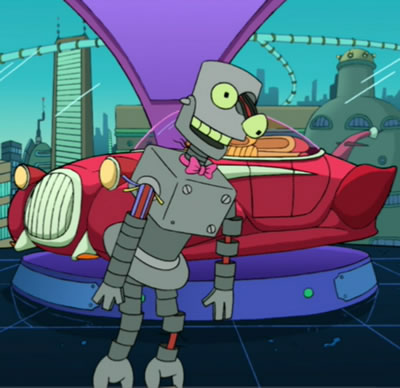
Roberto

Roberto is a violently insane robot who likes stabbing people, and has been incarcerated in the Hal Institute for Criminally Insane Robots repeatedly.  He has hilarious lines like, “Well, well, looks like old Roberto’s the focus of attention now.  Stop looking at me!  Ha ha ha ha ha HA!” and “I’m not crazy.  I’m just not user friendly.”  He didn’t show up until season three’s episode “Insane in the Mainframe,” but made eight more appearances.

.

Francis X. Clampazzo (AKA Clamps)

Not to be confused with Roberto, Clamps is part of the Robot Mafia run by the oblivious Donbot and is teamed with the gun-toting Joey Mousepad.  His specialty is killing people (or robots) using the clamps he has for hands.  What makes him stand out from the other mafiosos is his paranoia and sarcasm, like a robotic version of Joe Pesci.  The nine episodes in which Clamps appeared started with the season three story “Bender Gets Made (a.k.a. Bendfellas)“.

.

Tinny Tim

Season two’s “Xmas Story” introduced the crowd-pleasing Robot Santa, but also brought us another character who was featured more often, Tinny Tim–an orphanbot modeled after Tiny Tim from A Christmas Carol who has a crutch for an arm and speaks with a British accent.  In his seven other episodes, he is seen selling newspapers on a street corner, run over by a bus, and begging.  Despite his unlucky fate, he is eternally optimistic and is used for comedic effect, satirizing the use of small children to pull upon the audience’s heartstrings.

.

Malfunctioning Eddie

One of Roberto’s companions at the Hal Institute for Criminally Insane Robots is Malfunctioning Eddie, the owner of Malfunctioning Eddie’s Rocket-car Emporium.  He is often featured in TV commercials that spoof ones of bad local car dealers, as seen in his first appearance in season two’s “Put Your Head on My Shoulders“.  His problem is that every time he gets excited, his head explodes, which is frequently.  He exploded onscreen in six more episodes.

.

Hedonismbot

A throwback to the indulgent ancient Greek and Roman culture, Hedonismbot is a golden lounging robot willing to engage in any immoral or decadent activity (“Let us cavort like the Greeks of old!  You know the ones I mean”).  He’s present at any party, gathering, or social function to show off his status and wealth and partake in every conceivable pleasure.  Originally showing up in the first episode of season five, “Crimes of the Hot” Hedonismbot returned about a dozen more times.

.

Pazuzu

Making only two appearances, in season five’s “Teenage Mutant Leela’s Hurdles” and the film The Beast with a Billion Backs, Pazuzu is a possibly alien or demonic gargoyle owned by Professor Farnsworth that speaks French and grants wishes.  Names after an ancient Babylonian demon, the name is funny to anyone who ever saw Exorcist 2: the Heretic and had to hear Richard Burton utter that name countless times.  Of all the characters on this list, he desperately needs to return to the series.

(Professor Farnsworth searching for a video clip of Pazuzu)

.

Sal

Sal is Futurama‘s go-to guy as the typical New New Yorker.  Since the series’s second episode (“The Series Has Landed“) Sal has shown up numerously in various blue collar jobs: janitor, bus driver, impound lot worker, truck driver, impound lot worker, demolitions expert, robot repairer, sewage treatment worker, and so on.  He is lazy, mangles words, and has a strong New York accent.  He is the show’s everyman, seen every where at any time.

copyright © 2012 FilmVerse

1 Comment

Tim Burton Quiz

Tim Burton has one of the most distinctive visual styles of any filmmaker who ever sat behind a camera.  He is credited with creating a gothic style in cinema (thereby establishing himself as the default hero to goth teens everywhere).  His films mix humor with horror in an usual twisted and macabre manner, whether it’s people being blasted into red and green skeletons in Mars Attacks, the grisly murders of Sleepy Hollow and Sweeney Todd, the dark zaniness of characters like Beetlejuice or the Red Queen, or the creepy pastels of the “real” world as presented in Pee Wee’s Big Adventure and Edward Scissorhands.  Burton specializes in characters who are outsiders and can’t fit in with the rest of the world.  He reinvigorated the comic book movie with 1989’s Batman (the highest grossing movie at that time).  He has worked repeatedly with actors like Johnny Depp, Jack Nicholson, Helena Bonham Carter Michael Keaton, Winona Ryder, Christopher Lee, Paul Reubens, Michelle Pfeiffer, Catherine O’Hara, Jeffrey Jones, and many others, though his biggest collaborator is composer Danny Elfman, whose music is often synonymous with Burton’s skewed view.  How much do you know about Tim Burton’s films and career?  Take the following quiz and find out:

Take the Tim Burton Quiz!

After taking the quiz, scroll down to see more information about the questions (or cheat and skip the quiz altogether):

.

.

.

.

.

.

.

.

.

.

.

.

.

.

Last warning for spoilers!

.

.

.

.

.

.

.

.

.

.

.

.

.

.

1

Early in Tim Burton’s career, he worked for the Walt Disney Company as an animator, storyboard artist and concept artist for The Fox and the Hound and The Black Cauldron.

2

The first animated feature film Tim Burton directed was Corpse Bride (sharing credit with Mike Johnson).  Despite what many people believe, he did not direct The Nightmare Before Christmas–that was Henry Selick.  “Vincent” was a short animated film Burton did while working for Disney, and the upcoming Frankenweenie is an animated remake of his short film from the same era as “Vincent.”  All these films were done via stop motion animation.

3

Alice in Wonderland has made the most money domestically with $334,191,110, though if you adjust Batman‘s $251,188,924 for ticket price inflation, it would still be at the top with $492,934,700.

4

To date, Tim Burton has only been nominated for one Academy Award, which was for Corpse Bride in 2006 in the category of Best Animated Feature Film.

5

Including animated films and those to be released in 2012, Tim Burton directed Johnny Depp eight times:

  1. Edward Scissorhands (1990)
  2. Ed Wood (1994)
  3. Sleep Hollow (1999)
  4. Charlie and the Chocolate Factory (2005)
  5. Corpse Bride (2005)
  6. Sweeney Todd: The Demon Barber of Fleet Street (2007)
  7. Alice in Wonderland (2010)
  8. Dark Shadows (2012)

6

Before Tim Burton met Helena Bonham Carter, he dated Lisa Marie and cast her in four movies:

  1. Ed Wood (1994)
  2. Mars Attacks! (1996)
  3. Sleepy Hollow (1999)
  4. Planet of the Apes (2001)

7

Seven of Tim Burton’s feature films have never previously been filmed:

  1. Pee Wee’s Big Adventure (1985) – this movie was not an adaptation of Paul Reuben’s stage production The Pee Wee Herman Show, which was broadcast on HBO in 1981.
  2. Beetlejuice (1988)
  3. Edward Scissorhands (1990)
  4. Ed Wood (1994)
  5. Mars Attacks! (1996)
  6. Big Fish (2003)
  7. Corpse Bride (2005)

8

Tim Burton’s films are known for including as part of their visual style checkerboard floors, slanted architecture, and pasty white faces, but pentagrams is not something he normally includes (Sleepy Hollow notwithstanding).

9

Tim Burton directed three R-rated films: Ed Wood (1994), Sleep Hollow (1999), and Sweeney Todd (2007).

10

Danny Elfman did not score two of Tim Burton’s films: Ed Wood (1994) due to a falling out the two had; and Sweeney Todd (2007) because it was a musical scored by Stephen Sondheim.

* Information about the questions and answers taken from IMDb, Wikipedia, and Box Office Mojo.

copyright © 2012 FilmVerse

6 Comments

Best Spam Messages on FilmVerse

One of the banes of our modern existence is spam in our email inbox, but what I’ve learned since maintaining FilmVerse is that spammers also target the comment section of blogs.  Of course, we all had knowledge of this in an academic way thanks to all the Captchas that we have to wade through any time we log on to practically every website.  While WordPress is one of the easier systems, it still has its issues.

WordPress filters out a lot of spam from even reaching the blog, but what does slip by is sent to a special folder so readers won’t ever see these genius compositions, many of which attempt to sound like they are from a real person who read the article, but many times they consist of a random jumble of words that may or may not be English.  The one common component is that there is a website linked (sometimes the entry is filled with links) to an obviously commercial site.  It’s questionable as to why the people (robots?) sending out these messages think that they’ll be successful in fooling others into not only thinking what is written is real, but also to follow the link to the advertised websites and buy their services.  Often the messages sounds complimentary, but are oddly vague in their flattery.

Here is a compilation of some of the best spams sent to FilmVerse with the “author” credited.  The messages are written verbatim, with spelling, grammar, and punctuation errors intact for your reading pleasure (though long rambling nonsensical essays have been omitted).

“In the end the product is one that lends itself to being enjoyed in both a dancing and partying environment or an evening of attentive listening.”
— Measuring The Effectiveness Of Forex Intervention

(It’s great that FilmVerse causes people to dance and party.)

“Gorgeous essay, acquired the enjoyment of studying”
— firma curatenie in constanta

(Who said studying isn’t enjoyable?)

“Perfectly pent subject material , thankyou for information .”
— Lelia Entwisle

(Pent subject matter is exactly what we strive for.)

“Its great to see anyone make postings on this area.”
— Yellow Classic Flower Girl Dress

(Right, because posts about film and TV are so hard to find on the Internet.)

“Sign us up for Sofia Vergara’s diet/exercise regime. Really, you really only CAN do one or the other. At most.”
— Exercises To Get Ripped

(Sofia Vergar’s diet/exercise regime or what?  Give us another choice!)

“it is nice to hear from you and read your information here looks nice. grat job”
— gamani19785

(We strive to do a grat job.)

“Thank you for good post. It was very informative. I like a part about click here a lot”
— life insurance

(Click here is our most popular features.)

“I was reading through some of your blog posts on this site and I conceive this web site is very instructive! Keep posting.”
— SeeCrossgrove

(Glad you finally got instructions on how to conceive.)

“In case a brand-new post becomes available or assuming any changes occur on your site, I would love to read more. Aromatherapy Essential Massage Oil”
— sutra aroma

(Something smells fishy about this message.)

“Thanks for that awesome posting. It saved MUCH time”
— carpet cleaning 91360

(It is the goal of FilmVerse to save people time while reading posts.)

“Can I simply say what a relief to find someone who really knows what theyre speaking about on the internet. You undoubtedly know the way to deliver an issue to gentle and make it important. Extra people have to read this and perceive this aspect of the story. I cant imagine youre not more standard since you positively have the gift.”
— Trenton Ecklund

(Gentle delivery is FilmVerse’s specialty.  Send all your extra people here.  Is standard a compliment or an insult?)

“[Britensure Yellow Teeth] is really a tried and tested safe and effective merchandise that will provide you with some sort of assured eight pigments richer providing you with this confidant look which you have looking on to get.”
— gadaBrard

(Does Britensure cause or prevent yellow teeth?  But hey, we can be eight pigments richer!)

“It is possible to win the lottery on the very first try. You don’t have to mortgage your home to win a few bucks like so many people do. Are you confident that your lottery strategy will work? If you don’t have one, don’t worry about it…. knowing what can go wrong will make it easy for you to win the lottery.
It is also important that you re-invest a portion of your profits into your business! That way, not only will your business continue to grow, but its GROWTH RATE will also increase! This in turn brings in MORE profits, which allows you to invest MORE into your business… Do you see a pattern!?”
— bymnUnrergy

(How many people are mortgaging their homes to play the lottery?  No wonder we’re in a housing crisis.  It’s grat that not only will your business grow, but its growth rate will increase because those are two totally different things.)

“Thanks for another wonderful post. Where else could anybody get that type of information in such an ideal way of writing? I’ve a presentation next week, and I’m on the look for such info.”
— www

(Where indeed.  I can’t wait to see your FilmVerse presentation.)

Skipflyq…

Fantastic blog post, saw on…”
— Snappointq

(Saw on what?  Don’t keep us in suspense!)

“Hi! Quick question that’s totally off topic. Do you know how to make your site mobile friendly? My site looks weird when viewing from my iphone4. I’m trying to find a theme or plugin that might be able to correct this problem. If you have any suggestions, please share. With thanks!”
– Comprar enlaces en foros

(This one actually looks like it could be legit…)

“Hi! I could have sworn I’ve been to this website before but after reading through some of the post I realized it’s new to me. Nonetheless, I’m definitely happy I found it and I’ll be bookmarking and checking back frequently!”
— Comprar enlaces

(…oh wait, a second message from the same “person”.)

“Have you ever thought about adding a little bit more than just your articles? I mean, what you say is important and everything. Nevertheless imagine if you added some great images or video clips to give your posts more, “pop”! Your content is excellent but with pics and video clips, this site could definitely be one of the best in its field. Excellent blog!”
— Servicios SEO

(And a third, though this time the “name” changed but all other info like URL and IP address was the same.)

“Hey, I think your website might be having browser compatibility issues. When I look at your blog site in Chrome, it looks fine but when opening in Internet Explorer, it has some overlapping. I just wanted to give you a quick heads up! Other then that, excellent blog!”
— Servicios SEO

(This makes number four.)

“Hi there would you mind letting me know which web host you’re working with? I’ve loaded your blog in 3 completely different internet browsers and I must say this blog loads a lot faster then most. Can you suggest a good internet hosting provider at a reasonable price? Many thanks, I appreciate it!”
— Servicios SEO

(The fifth and final message from this robot.  For having such difficulty reading FilmVerse, he sure is persistent.)

“Thank you for you engaging, informative material. I believe many of the views you have mentioned in your article are sound and unique. It’s obvious you are a talented writer.”
— Ejercicios para hacer en casa

(We strive for sound and unique views, as long as it’s not a view of the Brooklyn Bridge, Florida swampland, or Arizona beachfront.)

“I am experiencing an issue with your rss feed . Don’t know why I am not able to subscribe to it. Is there anybody getting identical rss problem? Anybody who knows kindly respond. Thanks”
— gimnasia en casa

(This guy should talk with Servicios SEO.)

“Hey there! This post couldn’t be written any better! Reading this post reminds me of my previous room mate! He always kept chatting about this. I will forward this write-up to him. Pretty sure he will have a good read. Thanks for sharing!”
— Get senuke x

(Which post reminds him of his previous roommate?  One about Star Wars or Star Trek?  The Steven Spielberg quiz?  Screenwriting tips?  The Munsters?  Maybe it was the one about the fake Paul McCartney.)

copyright © 2012 FilmVerse

1 Comment

Structure: The Framework of a Screenplay

This article originally appeared on Screenwriters Daily March 18, 2012.

The most basic structure of telling a story is to have a beginning, middle, and end.  Screenwriting is a bit more complicated than this as not only do you have to tell a good story with interesting characters, but you have to adhere to a strict format including when to place various story elements.

The general rule of thumb is for a screenplay have a three-act structure: Act 1 is the beginning; Act 2 is the middle; and Act 3 is the end.  Given the maxim that one page of a properly-formatted screenplay is roughly equivalent to a minute of screen time, then each act would be approximately 30-pages for a 90-minute movie.  What about 2-hour films (or longer)?  It is an accepted practice that Act 2 is much longer than the others and can be an hour or more itself with a major turning point at the half-way point.  Some refer to this split as Act 2a and Act 2b, but for sake of argument, let’s say that this really constitutes two separate acts with an act break every half hour.

Each act has a specific purpose in the context of the story.  In order to better explain how the acts function, let’s analyze Jaws.  Any film can be used to demonstrate how a screenplay should be constructed.

Act 1

Act 1 is for exposition with three elements established: 1) the principal characters, in particular the protagonist and antagonist; 2) the setting, including the period the story takes place, primary locations, and tone that the setting evokes; 3) the central conflict that is the reason the story exists.  Jaws does a good job with all three.  The protagonist is Chief of Police Martin Brody, who transplanted his wife and two young sons from NYC to a small island community despite having a fear of the water only to find the town’s citizens and welfare threatened by a man-eating shark that he has to vanquish.  Amity Island is a character in its own right, with characters like Mayor Vaughn and Captain Quint adding color and conflict.  By the first half-hour mark, we know these characters, the setting, and the conflict.  Now the story can really get going.

It’s been said that the first few pages of any screenplay must have a “hook,” something that grabs the audience’s attention.  This is logical, since who wants to begin a movie (or a screenplay) by being boring?  Grab the audience with a scene that will draw in the viewer or reader with a scene that makes us understand what we are to expect.  In other words, start off with a bang.  Jaws does this in an unforgettable fashion with the death of a girl going for an evening skinny dip.  After this opening, how can anyone stop watching?  It sets up the fact that an unspeakable monster in the ocean is about to attack.  The following scenes introduces Brody, his investigation indicates a shark attack, and the local government’s concern that word of the attack will a detriment on money generated by summer vacationers.  Further attacks occur, and Brody finds himself in the position of having to stop the beast, which of course is the meat of the story.

By the end of Act 1, there needs to be a major event that sends the story moving, often caused by the protagonist making a decision that has long-reaching consequences; if the character had made a different decision, then a completely different story would ensue.  In Steven Spielberg’s shark film, Act 1 ends with the introduction of shark expert Matt Hooper, who determines that indeed the girl from the beginning was killed by a shark rather than a boating accident as the coroner was forced to conclude, so something still must be done to stop the menace.

The mistake many people do during Act 1 is forget what its purpose is and wanting to jump into the main action too soon.  The audience needs to know who the story is about, where and when it takes place, and what problem needs to be solved by the end.  Use every scene to develop these three points.  If you want to introduce a theme at this time, it’s acceptable, but the rest of the movie can be used to develop your ideas.

Act 2

If Act 1 is “the boring stuff” that people often skip over after seeing a film repeatedly because they don’t need to see the set-up again, then Act 2 is the good stuff.  This is where the story really takes off, beginning around page 30.  By now, we know the principal characters, the world in which they exist, and the situation they have to deal with, so now we can have fun throwing all sorts of problems their way.  In literary terms, this is the rising action; we’re elevating the conflict (AKA thickening the plot).  Brody and Hooper have to contend with the inaction of the local officials, handle the guilt from a victim’s mother, prove that a shark fishermen killed is not the man-eater stalking their waters, investigate an abandoned boat, and manage the Fourth of July crowd on the beach all while the evil fish is still on the loose.

It is very important to be efficient during Act 2.  Make every scene count; if a scene does not advance the plot or develop a theme, then cut it or combine it with one that does.  Many times people complain that a movie has a strong start and finish, but drags in the middle.  This is due to the writer losing focus on what the story is.  Use scenes like building blocks.  You’re moving from the last turning point to the next one, so everything in between needs to propel the story toward it.

Turning Point (Act 2B or Act 3)

About an hour into the film, or around page 60 in the screenplay, the story spins in a different direction with some unexpected event.  For the next half hour, we’re still in the middle of the story, but the characters are dealing with developments vastly different than what transpired in the first half of the story.  The difference between a 90-minute movie and a 2-hour (or longer) film is that with the shorter length still has a turning point, but the ramification of it are dealt with in a much shorter time period.  Often, this section is only 10-20 minutes long before moving into the conclusion.  Longer movies will obviously take advantage of the time to build up to the final act.

At the hour point in Jaws, panic takes hold on the Amity Island beach after two kids pull a prank, but then the real shark attacks, endangering the sons of both Brody and Mayor Vaughn.  This prompts the mayor to hire Quint, thereby setting into motion the triumvirate of Brody, Hooper, and Quint that will continue until the end of the film.  This new dynamic brings in a new conflict, that of old salt sea captain Quint going against college-educated scientist Hooper.  This rivalry is one of the more entertaining aspects of the movie and develops the theme of old fashioned techniques vs. modern technology.  They go out on the water in Quint’s boat the Orca, where Brody finally sees the monster he’s up against.  They don’t truly understand the magnitude of the threat against them until the shark attacks the boat during an evening bonding session.  This segment wraps up at an hour and thirty-six minutes, running slightly long according to tradition, but it still works as an act break.  By this point, there is another turning point that leads toward the inevitable conclusion–in this case, the turning point is that attack.  The three men now have their own lives in peril, as the ship has been damaged, they are dealing with an unpredictable enemy, and human failings may be their undoing.

The Final Act

What is typically known as Act 3, unless you prescribe to the theory that each act is approximately a half hour long and thereby enabling more acts than the traditional three, is your story’s finale.  This encompasses the climax and falling action, which is where everything is resolved in a thrilling manner, followed by any other loose ends being wrapped up before the credits roll.

In Jaws, this is primarily the depiction of the final showdown between men and shark.  However, it also illustrates the conclusion of individual story arcs: Brody overcomes his hydrophobia through the showdown with his nemesis; Hooper proves his masculinity by submerging himself in a shark case to go face-to-face with the big fish; and Quint puts aside his pride and hubris to allow new ideas on how to catch the shark, though allowing his obsession to finally best him.  There’s not much of a falling action–after the shark is destroyed in a spectacular and edge-of-the-seat manner, we are treated to a mostly silent reunion of the survivors and their swim back to shore.  Some stories need a lot of resolution, so after the climax the film may go on for another ten to fifteen minutes depending what is required for the audience to leave the theater satisfied.  When nothing more needs to said, then that is time to end the film.

One mistake that often happens is to continue the story far longer than what is necessary, which results in the audience growing impatient and irritated at the movie.  Don’t be afraid to write “The End” when the time comes.  Conclude with a strong emotion, whether it’s a joke, a shock, a tender moment, or one of sadness.  The ending of any story is the last impression you have to make with the audience, so make it a good one.

copyright © 2012 Jamie Helton