14 Comments

Star Lord of the Potter Rings Wars

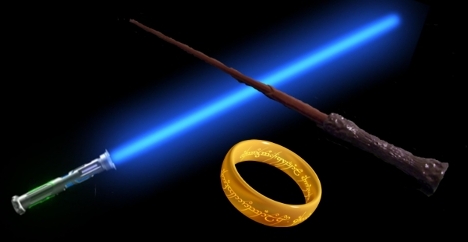
Ask anyone who has seen Avatar and wants to be snarky about it, the plot of James Cameron’s epic Science Fiction adventure bears a strong resemblance to Dances with Wolves, Pocahontas, and Fern Gully.  The similarities between Forrest Gump, Big Fish, and The Curious Case of Benjamin Button has already been explored.  Now let’s take a look at the elements of three iconic fantasy/SF series: Lord of the Rings, Star Wars, and Harry Potter.  For the sake of argument, this list only refers to the film versions of the stories (sorry, Tom Bombadil and Old Man Willow), and only events referred to in the original trilogy of Star Wars will be used.  How close are the adventures of Frodo Baggins, Luke Skywalker, and the Boy Who Lived?
Story

Rings Wars Potter
Based on a series of books

X

X

Is influenced by classic mythology

X

X

X

Features a variety of fantasy characters

X

X

X

Invented a new language for races of characters X

X

 X
Involves an epic journey

X

X

X

Hinges on magical jewelry that has destructive properties

X

X

Politics have broader reach in the story than the hero’s goal

X

X

X

Mythology that predates the hero’s birth

X

X

X

Interaction between humans and other races of creatures

X

X

X

A birthday is the catalyst for the events in the story

X

X

A gathering of leaders meet to discuss what to do about fighting the growing evil, though leave the heroes out of the discussion

X

X

Historical sword that is important to the plot

X

X

X

Basin of seeing is used by the protagonist

X

X

Attack on a fortress  or base of operations where the good guys are hiding

X

X

X

Prophecies about the hero

X

X

An object that creates light in dark places

X

X

Protagonist

Rings Wars Potter
Is an orphan

X

X

X

Lives with uncle

X

X

X

Has humble beginnings

X

X

X

Has a psychic connection with the villain

X

X

X

Has a scar that hurts when evil is near

X

X

Suffers a disfigurement

X

X

x

Uses a glowing weapon

X

X

X

Uses some form of magic

X

X

Can turn invisible with help of a special device

X

X

Has a battle with the villain during the climax of the series

X

X

Is an unlikely hero

X

X

X

Follows in the footsteps of an older relative

X

X

Possess an object that the villain seeks

X

X

X

Witness the death of their mentor and is unable to stop it

X

X

X

Disguises himself in enemy uniform to sneak through enemy territory

X

X

Sees a vision of his friends being tormented, so he springs into action to save them

X

X

Struggles with being overcome by the powers of darkness

X

X

X

Is willing to die for his cause and believes this will be the outcome of his journey

X

X

X

Sees good in a seemingly evil character

X

X

Villains

Rings Wars Potter
Returns from the dead to reclaim his power

X

X

Chief villain remains largely unseen through much or all of the story so that the idea of him is worse than his reality

X

X

X

Has a hierarchy of villains

X

X

X

A bad guy proves there is good in him

X

X

Mentor

Rings Wars Potter
Is elderly

X

X

X

Has a gray beard

X

X

X

Wears robes

X

X

X

Performs a form of magic

X

X

X

Sends the hero on his journey

X

X

X

Dies, but continues to mentor the hero

X

X

X

A person close to them gave in to the forces of darkness

X

X

X

Member of an order that exists to protect their world

X

X

X

Though of by the younger generation to be crazy

X

X

X

Best Friend

Rings Wars Potter
Is used for comic relief

X

X

X

Has a change of character and becomes heroic

X

X

X

Sometimes clashes with the hero

X

X

X

Mostly serves as a sidekick for the hero without doing much through a good portion of the story

X

X

Gets the girl at the end of the series

X

X

X

Primary Female Character

Rings Wars Potter
Holds her own in a fight

X

X

X

Is a princess

X

X

Her bloodline is an issue

X

X

Other Characters

Rings Wars Potter
Duo of humorous characters who prove useful despite their initial goofiness

X

X

X

A small, strange-looking creature that talks in an annoying, high-pitched voice or odd syntax

X

X

X

Sneaky employee of the villain with “Worm” in his name

X

X

Dark, scary hooded creatures that travel in packs and threaten the heroes

X

X

A giant spider

X

X

A secondary villain with long, white hair

X

X

A secondary hero is a rogue with a shady past who lives on the fringe

X

X

A large, hairy, and loveable sidekick to the heroes

X

X

Supporting character who betrays the heroes due to self interest, but regrets his actions and becomes heroic

X

X

Settings

Rings Wars Potter
A dangerous forest

X

X

X

A world similar to our own, but with magical elements unknown to most

X

X

Castle fortress or other impenetrable, heavily-armed secure place

X

 X

X

A water-logged location filled with the dead

X

X

A pub where major plot points take place

X

X

X

Underground tunnels where a fight occurs

X

X

Snow-covered land where battle occurs

X

X

Swamp

X

X

Feel free to add to anything in the comments section that may have been overlooked.

As a bit of interest, according to Boxoffice Mojo, here are the worldwide gross receipts for each of these series:

  • Lord of the Rings (3 movies): $2,917,506,956
  • Star Wars (6 movies): $4,314,075,262
  • Harry Potter (8 movies): $7,706,147,978

In comparison, here are the box office totals for other fantasy series:

  •  Twlight Saga (4 movies with 1 more film yet to be released): $2,508,379,328
  • The Chronicles of Narnia (3 movies): $1,475,977,950
  • The Hunger Games (1 movie with 2 more proposed films—The Hunger Games is still in the theaters): $631,952,067
  • The Avengers and the films leading up to it (6 movies—The Avengers is still in the theaters): $3,323,643,375 [yes, this is technically a comic book movie and not true fantasy/SF, but it’s good for comparison’s sake]

copyright © 2012 FilmVerse

10 Comments

Basics of Screenplay Format

This article was originally published at screenwritersdaily.com on April 24, 2012.

This may be obvious, but the purpose of screenwriting is to end up with a motion picture.  This basic yet essential fact is why the screenplay format is so important.  Much like plays require a format agreed upon by those who put on stage productions and poetry has rules regarding meter and verse, screenplays follow a specific manner of putting the words on the page.  The reason for this is simple–a screenplay must communicate to the actors, director, and all production personnel what is to appear on screen.  Unlike a novel, which requires only the author and perhaps an editor, a screenplay is used by possibly hundreds of people, and they all need to understand exactly what is meant by the screenwriter.

The usual analogy people use is that a screenplay is the blueprint for a movie; this is a fairly accurate description, because an architect drafts a blueprint for a building and hands it off to a construction crew to use as a guideline to build their project like a screenwriter turns his screenplay over to the film crew to produce the motion picture.  If an architect did not use established guidelines, symbols, and visual clues in his blueprint, the crew would not know how to proceed with their construction; similarly, a screenwriter must adhere to established formatting to effectively communicate to the film crew.

Sometimes formatting rules for screenplays seem random, but there is a practical reason for everything.  For instance, the page count for a properly-formatted screenplay is used to estimate the length of the final film as one page roughly equates to one minute of screen time.  Of course, this is not exact due to the amount dialogue and action used on the page, plus the manner in which the director shoots the scenes.  Regardless, it’s a good rule of thumb.

The basic elements consist of scene headers, action, and dialogue, though there are other items to be aware of, like the title page, page numbers, and parentheticals among others.  Once you get the hang of how the page is supposed to look and what goes where, you will then be able to be creative and let your story flow.

Screenwriting Programs

Be aware that there are many computer programs designed to take the worry out of formatting.  If you can focus just on the actual writing process and not think about the format, it makes the life of a screenwriter a lot easier.  The industry standard is considered to be Final Draft, but Movie Magic Screenwriter is also popular and has a lot of great features.  Either of these will cost somewhere in the neighborhood of $300, but it’s a worthwhile investment.

If you’re on a limited budget, there are some free alternatives.  Celtx is a rather powerful free downloadable program that can be used for various formats such as screenplays, theatrical plays, television scripts, comic books, and novels.  It is a great tool for independent filmmakers as it also has a scheduling feature and allows you to import photos for storyboards.  They recently introduced a cloud server for Celtx if you need the flexibility to access your work from any computer.  Along those lines, you can sign up for Five Sprockets or Scripped to write your screenplays online.  All three of these options are fantastic if you collaborate with other writers.  Be aware, though, that each has its own limitations and may not give you full control over formatting choices, such as choosing the number of lines between scenes, which both Final Draft and Movie Magic Screenwriter allow.

If you still insist on using Microsoft Word or some other text editor to write your screenplay (highly unrecommended), you can use a formatting syntax that screenwriter John August developed called Fountain.  Regardless of what program you use, you still need to know the basics.

Title Page

Keep the title page simple without graphics or fancy fonts (use standard 12 point Courier for the entire script, including the title page).  This is the first impression readers will have, and you want it to look professional.  While the instinct to make your screenplay stand out from the others is strong, it will mark you as unprofessional and can draw the wrong attention to your work.  Here is what you need on the cover page:

  • Center the title of the script using all caps (some experts suggest underlining it, while others do not, so that is optional).
  • Place your name double spaced under the title, centered.
  • At the bottom right of the page, list your contact information.  This is extremely important, as cover letters accompanying the script will probably be misplaced, and you never know who the script will be handed off to.  You want anyone and everyone to be able to get a hold of you in every way possible.
  • Place the copyright year of the screenplay on the bottom left.  Be aware, though, that this will literally date your script, so it will have a limited shelf life.
  • It is highly suggested to register the screenplay with the Writer’s Guild of America or the U.S. copyright office, but it is unnecessary to list your registration number on the cover of the script, as most companies assume you have done this and find it insulting that you feel the need to tell the world that it’s registered.  It is acceptable to place “registered, WGAw” on the bottom left of the cover page under the copyright date and leave off the actual registration number.

Scene Headers/Slug Lines

Every scene begins with a scene header, also known as a slug line.  The purpose of this is to simply and efficiently establish the setting of the scene.  A new scene header is needed every time the setting changes.  The scene header should be typed in all caps flush against the left margin.  It is composed of three elements:

  • Use EXT. if the scene takes place outdoors (exterior) or INT. if the scene is inside a building, vehicle, etc. (interior).
  • State exactly where the scene takes place, i.e. HOUSE or BACK YARD.  Put a space, one dash, and then another space before the next element.
  • List the time of day.  It is suggested to keep this to either DAY or NIGHT, though DUSK and DAWN is used if the scene must take place while the sun is setting or rising.  Do not use MORNING, NOON, AFTERNOON, etc.  If characters move from one location to another, it is acceptable to use CONTINUOUS in place of the time of day, since this is a continuation from the previous scene.

Scene headers are very important for the production personnel when breaking down the script, and these three elements are needed information for the script break down and scheduling.  A popular style is to use the full scene header when establishing a primary scene, like a character’s house, and then use a shot for individual rooms within that location.  In this case, you would just place the name of the room on a single line in all caps, like

LIVING ROOM

followed by the action in the scene.  This streamlines the script and makes for a quicker read, but be aware that the effect of doing this is that it give the Production Manager more work to do.  A shot can also be used to denote a character’s point of view (POV), or when seeing through that character’s eyes.

Here are a few more considerations regarding scene headers:

  • Different screenwriters have preferences as to how many spaces to use between scenes.  It is traditional to triple-space after a scene (two blank spaces) in order to have a visual break between scenes.  However, some writers prefer to only double space (one blank space) in order to condense the script and have a slightly smaller page count.  Some on-line screenwriting programs do not give you an option.
  • Do not number the scenes.  This is only done when the script is finalized as a shooting script to be used by the production crew.
  • A new trend is to put the scene header in bold and underlined.  This is optional, though unnecessary.  However you decide to format the scene headers, be consistent throughout the entire script.
  • If you have to specify a room within a larger location, divide it with a slash listing the primary location first, such as “HOUSE/KITCHEN”.

Action

The action is description of what the characters do.  Begin this at the left margin after double-spacing after the scene header, using mixed cases.  Keep the action simple–you are not writing a novel, so flowery language is irrelevant.  Some writers use fragments and even one-word sentences to be more visual than literary.  You want the reader to keep turning the pages and to visualize the action.  The more white space on the page, the better.  Here are some rules to follow regarding action:

  • Margins should be set at 1.5″ from the left and 1.0″ from the right.
  • Keep paragraphs, or action blocks, at no more than four or five lines maximum.  On the other hand, do not make every sentence its own paragraph.
  • Each paragraph should be its own “shot.”  If you see the camera angle changing, use a new action block.
  • Write in present tense.
  • When a character is introduced for the first time, use all caps for the character’s name.  Use mixed cases for the rest of the screenplay.  Also, list the character’s age by separating the number with commas.
  • At one time, it was standard to put all elements in all caps, such as sound effects, animals, vehicles, props, etc. as a way to flag these elements for production personnel.  However, each department head will do his/her own script breakdown looking for elements needed for that department; doing this for them just makes your job more complicated and it causes the script look cluttered with every other word in all caps.  Some writers only highlight sound effects this way.  It is acceptable to avoid doing this altogether and just focus on the story.
  • Do not give camera direction (i.e. “zoom in on character’s face” or “pan across the horizon”).  Let the director choose the shots (he/she will anyway).  Write in “master scene” format where you describe all the action in the scene as if in a play, but imply camera angles using paragraph breaks and the way you describe the action.
  • Be careful with the use of ellipses (…) and dashes.  It is easy to overuse ellipses, but only use this punctuation if something trails off, so is best used with dialogue (be aware not to overuse it here, either).  If action is interrupted, or if leading into a new scene, use an em-dash, or double dash (–).  A single dash should only be used as a hyphen to link two words.
  • Do not describe a character’s thoughts or feelings.  If necessary, an inner monologue can be done using narration.  The only thing that should be described is what can be seen on screen.  This includes background information on the characters or other motivation.
  • At one time, if a scene bled over to a second page, it was necessary to write “CONTINUED” at the bottom of the page and then at the top of the next page.  This is rather insulting to the reader, who can obviously figure out that the scene is continuing since there’s no scene header at the top of the next page.  This is just extra words to worry about, so avoid it.  Some screenwriting programs allow you to turn this feature on or off.

Dialogue

It is said that a screenplay should only include what can be seen and heard.  The dialogue is the second half of that, as it is what the characters say.  For dialogue, you must list the character who is speaking, what the character says, and a few other formatting specifics, such as the following:

  • Write the character name in all caps and set the margins at 4.2″ from the left and 1.0″ from the right.  This is not centered, but the first letter in all character names lined up to make it easier for the actors to skim down a page and find their own dialogue.
  • Begin the dialogue on the next line after the character name with the margins at 2.9″ from the left and 2.3″ from the right.
  • If a character is speaking off screen, such as from another room, then use “(O.S.)”.
  • If a disembodied voice is heard on the soundtrack, such as narration or a voice on a radio, use “(V.O.)”.
  • Parentheticals should be placed on a line of its own between the character name and the dialogue with the margin settings of 3.6″ from the right and 2.9″ from the right.  Use parentheticals sparingly, and avoid telling the actors how to say a line (it’s their job to figure that out).  The best use of “wrylies” is if a line is to be said in a way opposite than how it appears on the page so that it’s not intuitive.
  • If an action is in parentheses, it should be something that is to done along with the dialogue, such as the character looking out a window while speaking.  Longer actions should be separated out in an action block.
  • If a character’s dialogue is broken by a page break, use “(MORE)” after the dialogue break, and then “(cont’d)” after the character name on the subsequent page.  Similarly, “(cont’d)” should be used if dialogue is interrupted by action.
  • If you intend for a pause to be in a line of dialogue, use “(BEAT)” on a separate line between the sections of dialogue.
  • Avoid long speeches.  If a character must speak for a lengthy amount of time, break up the dialogue by bits of action, such as some small business the character does or reactions from others.  This prevents a long section that must be read.
  • Keep the dialogue character-based and avoid simply using dialogue for exposition.  However, get to the heart of what is being said and cut out anything extraneous.  Every word should be meaningful.
  • Overlapping dialogue (two characters speaking at the same time) is done with columns.  Programs like Movie Magic Screenwriter can handle it, but Celtx cannot.
  • As with the action, do not confuse ellipses with dashes.  Use ellipses if a character’s dialogue trails off, as if in thought.  Use an em-dash if a character’s dialogue abruptly ends or is interrupted mid-sentence.
  • Spell out numbers and words that are normally abbreviated (such as “Mr.”) in dialogue.  This gives a more accurate length for speaking these words.

Other Considerations

Here are some other things you need to be aware of:

  • Place page numbers at the top right of the page, but do not number the first page of the screenplay.
  • Three-hole punch the pages and use two brass brads, leaving the middle hole empty.  The purpose is for ease of disassembling and reassembling the script if copies are made.  Three brads just add extra work and show that the writer is out of the loop.
  • Use plain white card stock for covers with no title on the front when submitting the script to studios or agents.
  • Begin the script with “FADE IN:” and end with “FADE OUT.”  Some writers are forgoing this, as it is seen as extraneous, but this is traditional.
  • Center “THE END” at the end of the screenplay.
  • Avoid using transitions unless absolutely necessary.  At one time, “CUT TO” was placed at the end of every scene, but this is obvious to the reader as well as taking up space unnecessarily and creating more work for the writer.  If a transition is necessary, place it 2.5″ from the right margin (or 6.0″ from the left margin).
  • Always spell check.

There are several good websites and a plethora of books written by such authors as Syd Field, Mary C. Johnson, and J. Michael Straczynski go in-depth into the craft of screenwriting.

copyright © 2012 Jamie Helton

48 Comments

Poll: What Sequels Do You Wish Were Never Made?

Despite the fact that everyone seems to bemoan sequels, excitement grows when it is announced that a follow-up is in the works for a popular movie.  The Avengers has not even been in American theaters a week, and yet Disney has already announced plans for a part 2–and it’s unlikely that many people are protesting that.  However, audiences are fickle; there are few complaints as long as the sequels are entertaining, but as soon as one film in a series hits a sour note, the fan community acts like it’s the second coming of Hitler.  Just look at Spider-man 3, which brought about the end of Sam Raimi’s superhero series despite making  $890,871,626 worldwide at the boxoffice.

Some movie series are pretty lousy to begin with, so, for instance, it really doesn’t matter how bad the next Leprechaun movie is because fans of that series expect as much.  But how many people avoid the original Jaws because they associate every movie in that series with growling sharks that leap out of the water only to explode when impaled by a sailboat?  Often, an excellent film will spawn cringe-inducing sequels that often are the death-knell of the series.  Occasionally, a series can overcome a stumble like Star Trek V: The Final Frontier, but all too often the result is a Batman & Robin where the only way to recover is to reboot the franchise.  Of course, there’s also series fatigue that happens when so many sequels are made that the filmmakers just run out of creative energy, hence Rocky V and A View to a Kill.  There’s also the completely unnecessary sequel to a blockbuster like Speed 2: Cruise Control that is completely inexplicable in its existence (though that can be said for quite a lot of sequels).

The question then is which sequel do you wish was never made?  This can be because it ended a terrific series of films, it tarnished the reputation of a classic, or it just angered you beyond belief by its badness.  Take the poll vote for as many as you want, and feel free to add one that did not make this list.  I’m sure there are many more out there!

Note:  The Star Wars prequels were not included in the poll because, well, they’re prequels and not sequels.  Also not on the list are any direct to video sequels like the Disney animated cash grabs, as those are just too obvious.

© 2012 FilmVerse

22 Comments

Stephen King Short Fiction That Should Be Adapted as Films

This article was originally published on showwatcher.com on April 26, 2012.

Stephen King is as closely associated with motion pictures as he is with publishing, thanks to huge hits based on his books such as Carrie, The Shining, Stand By Me, Misery, and The Shawshank Redemption, among many others.  King himself has written screenplays for films like Creepshow, Pet Sematary, Cat’s Eye, and Sleepwalkers, plus creating two TV series and writing three mini-series.  Of course, so many of his stories have been adapted into movies that quite a few have been done badly–Graveyard Shift and the various Children of the Corn flicks come to mind.  Stephen King himself is to blame for Maximum Overdrive, having both written and directed that fiasco.

With a plethora of film and television productions originating from King’s imagination, it’s easy to think that his publishing catalog has been bled dry.  However, there are nearly 30 of his novels that have yet to be adapted in any form.  That does not even count his short stories and novellas that have been published in nine collections.  His literary work could literally keep the movie industry in business for years.  Some of his short fiction would not translate into film due to subject matter or simply the length of the story (The Lawnmower Man is a good example of this, despite the attempts by the filmmakers), but quite a few would make fantastic features.  Here are ten short stories or novellas written by Stephen King that should be adapted as motion pictures.

I Am the Doorway

Night Shift, 1978; originally published in Cavalier magazine, March 1971

For those people who still think Stephen King only writes horror (despite The Shawshank Redemption, Stand By Me, Dolores Claiborne and The Dark Tower series), it would surprise you to know that he has wandered into the realms of science fiction, fantasy, and character-based drama.  His work often mixes a variety of genres, and “I Am the Doorway” is one of them, combining science fiction and horror.  It tells the story of an astronaut who returns to Earth only to find eyeballs erupting on his fingertips.  These eyeballs act as “doorways” for aliens to see our world, though terrifyingly distorting the images.  The aliens take control of the astronaut and cause him to go on a murder spree against his will.  He must fight against the unearthly forces at work inside himself.  This would make a taut, suspenseful science fiction thriller unlike anything else seen in the theaters.

The Man Who Loved Flowers

Night Shift, 1978; originally published in Gallery, August 1977

The Man Who Loved Flowers” is Stephen King’s take on a psychotic serial killer, though that turns out to be the twist at the end of the short story.  A man seemingly in love purchases flowers for his girlfriend, but it turns out that he meets random women who he thinks is his beloved Norma and kills them when he realizes that they aren’t her.  The real Norma had died ten years previously, and grief drove him insane.  As a movie, this could play out much like Alfred Hitchcock’s Frenzy, where the murderer is a regular, nice guy in normal situations, but something triggers his psychosis that causes him to kill.  We follow detectives trying to solve the series of murders.  The only clue is the flowers left by the bodies, which eventually leads the detectives to discover the truth.  Can they find the killer before he locates another Norma?

The Jaunt

Skeleton Crew, 1985; originally published in The Twilight Zone Magazine, 1981

© Darek Kocurek

Another excellent science fiction story, “The Jaunt” is set in the future where teleportation to Mars is as common as traveling via airlines.  There are actually two parallel plot lines: the first about a family preparing for their jaunt; the second an extended flashback sequence involving the inventor of the teleporter, as told by the father of the family.  It turns out that one must be unconscious when being “Jaunted” to avert insanity or death.  The scientist who developed the technology first discovered “the Jaunt effect” among mice he used for early tests, then later on a prisoner who volunteered in exchanged for parole–who lived long enough to indicate that the dimension they must travel through exists in a much longer time period than we experience.  In movie form, the futuristic family scenes would serve as the backdrop to the true story, that of the development of technology that has the potential to go very wrong but in a different manner than was developed in The Fly.

Mrs. Todd’s Shortcut

Skeleton Crew, 1985; originally published in Redbook magazine, May 1984

© Darek Kocurek

Another type of science fiction travel, through worm holes, is explored in “Mrs. Todd’s Shortcut,” where a man learns that the eponymous character has discovered ways to drive distances that are seemingly impossible.  She compares her shortcuts to folding two points on a map together.  The man explores these shortcuts, finding himself in a world where monstrous animals live among trees that attack, and anyone who travels these routes seem to grow younger.  A movie version could use this story as a starting point and go further into exploring what exactly lies in these strange lands and why the worm holes exist in the first place–as well as what threat they may pose to our world.

The Reach

Skeleton Crew, 1985; originally published as “Do the Dead Sing?” in Yankee, 1981

Stephen King often writes books that prominently feature woman–Carrie, Misery, Dolores Claiborne, Gerald’s Game, Rose Madder, and Lisey’s Game to name a few.  “The Reach” is no exception, except for the fact that the female protagonist is 95 years old.  She has lived on Goat Island her entire life, but as cancer eats away at her, she begins seeing the ghosts of loved ones like her husband, who urges her to cross the reach to the mainland.  She heads out in a blizzard, where she is surrounded by family and friends escorting her to her final destination.  While this is a ghost story, the ghosts are not presented in a horrific manner but in a rather sentimental one.  Like Dolores Claiborne, if this is expanded into a feature length, the main character’s past can be explored in a mature manner and the true horrors of life–devastating illnesses, growing old alone and lonely, and the reality of death–can be explored using the ghosts as a supernatural framing device.

The House on Maple Street

Nightmares & Dreamscapes, 1993

© Chris Van Allsburg

Like many of King’s stories, “The House on Maple Street” uses the supernatural to deal with real-life issues, whether it’s racism, religious mania, abortion, spousal abuse, or bullying.  In this case, it’s child abuse.  The four Bradbury children featured in the story live with an abusive stepfather, but find a way to get rid of him when their house begins to change.  Something replaces the building materials with metal, turning their home into a giant machine that counts down to some calamity.  This premise could easily become an entertaining film that kids would relate to, something that is rare with Stephen King films.  A sense of awe would turn into dread, and finally to victory as the kids use their bizarre situation to escape an even worse, real-world one.

Everything’s Eventual

Everything’s Eventual, 2002; originally published in The Magazine of Fantasy & Science Fiction, October/November 1997

The novella “Everything’s Eventual,” which was featured in the collection of the same name, joins King stories such as Carrie, The Dead Zone, and Firestarter where the main character has a psychic power that does miraculous things, but has potentially disastrous consequences.  In this case, a 19-year-old high school dropout has the ability to psychically brainwash people through his drawings.  He uses this gift to cause his overbearing boss to commit suicide, after which he is recruited by a secretive organization to assassinate people by emailing them his illustrations.  However, when he learns the truth about one of his targets, guilt over his actions take over and he comes to understand that his employers are evil.  He plots an escape.  The movie can be similar to adaptations of Philip K. Dick stories where you have a person embroiled in a science fiction conspiracy far more complicated that he is prepared to face and must take down the bad guys using his wits and skills.

The Things They Left Behind

Just After Sunset, 2008; originally published in the collection Terror’s Echo, 2005

The events of September 11, 2001 have etched themselves in our public consciousness.  Stephen King’s way of dealing with his feelings about those terrible events was to write “The Things They Left Behind,” which deals with a man who worked in the World Trade Center, but took the day off that fateful day.  He deals with survivor guilt, and then the supernatural intervenes–items belonging to his dead co-workers appear in his apartment.  In order for him to heal, he must track down the immediate family of the dead owners of these objects and pass the things along to them.  While this may sound sentimental and somewhat similar to the saccharin Extremely Loud and Incredibly Close, remember that this is done in Stephen King style with true horrors being depicted.  Of course, a movie with this subject matter must be handled sensitively, and if the right tone of reality and fantasy is met, this could be an emotional experience along the lines of The Shawshank Redemption.

1922

Full Dark, No Stars, 2010

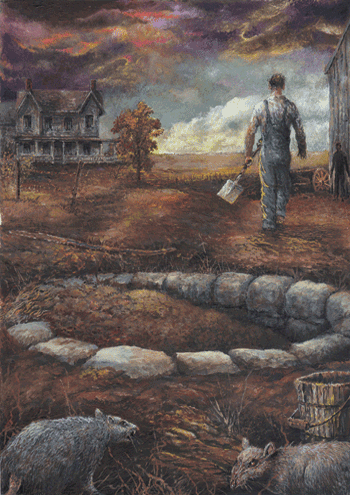
Novellas lend themselves best to film because of their length as the plot neither needs to be condensed nor embellished.  “1922” is a good example of this.  Set in the title year, a farmer convinces his 14-year-old son to help murder his wife, who wants to sell the farm to a slaughterhouse and move to the city.  They successfully convince the sheriff that the woman deserted them, but life is anything but happy.  The farmer becomes convinced that his dead wife is now haunting him due to an infestation of vicious rats.  Understandably, his son grows emotionally unstable and ultimately runs off with his girlfriend for a life of crime that ends tragically.  The farmer spirals into a life of desperation and possible insanity as he perceives the rats stalking him from town to town.  This is pure Stephen King using imaginative horror to give characters who make bad choices a fitting end.  The human drama alone could make a poignant film, but with the layer of the questionable sanity of the protagonist and the visions he sees would bring this film into terror territory.

Big Driver

Full Dark, No Stars, 2010

In the novella “Big Driver,” King forgoes the supernatural for realistic scares, again exploring the nature of a serial killer.  This is another story that features a strong female lead, a mystery writer who succumbs to events right out of one of her own books.  After a public appearance, she takes a shortcut that leads through the middle of nowhere–and right into a trap.  She finds herself at the mercy of a large truck driver who at first seems helpful, but then beats her and leaves her for dead among the bodies of previous victims.  After escaping, the writer plays detective and tracks down her would-be murderer, only to find a larger plot than she ever anticipated involving a very twisted family.  This violent Hitchcockian thriller is full of twists that the audience cannot anticipate, and would keep them on the edge of their seats.

As a footnote, Stephen King offers the rights to certain short stories to amateur and student filmmakers for a buck as part of his Dollar Babies program.  Currently, four of the stories listed in this article (“I Am the Doorway,” “The Man Who Loved Flowers,” “The Reach,” and “The Things They Left Behind”) are available.  The contract for Dollar Babies prohibits the filmmakers from making a profit off these films, and distribution is limited to film festivals and demo reels.

© 2012 Jamie Helton

2 Comments

Oscar Quiz: Best Cinematography

Roger Deakins, ASC, BSC

This article was originally published on showwatcher.com on 4/20/12.

It seems that the Academy Award categories that everyone cares about is Best Picture, Best Director, and the acting awards.  However, when you think of the films that are worthy of taking home the little golden man, what you picture is largely the amazing visuals from those movies.  Who is responsible for the memorable images?  The cinematographer, also known as the director of photography, oversees the lighting and camerawork.  A director can have a wonderful eye, but without his trusted D.P. at his side, his vision won’t make it to the big screen.  Steven Spielberg has Janusz Kaminski, Christopher Nolan has Wally Pfister, Martin Scorses has Robert Richardson, Oliver Stone has Robert Richardson, Quentin Tarentino has Robert Richardson.  But how much do you know about these magicians of light and shadow?  Click the button below to take the Best Cinematography Oscar Quiz:

Take Best Cinematography Oscar Quiz!

After taking the quiz, scroll down to see more information about the questions (or cheat and skip the quiz altogether):

.

.

.

.

.

.

.

.

.

.

.

.

.

.

Last warning for spoilers!

.

.

.

.

.

.

.

.

.

.

.

.

.

.

1

The two winners who tied at most Academy Awards for Best Cinematography received 4 Oscars each.

Leon Shamroy

  • The Black Swan – 1953*
  • Leave Her to Heaven – 1946
  • Wilson – 1945
  • Cleopatra – 1964

Joseph Ruttenberg

  • The Great Waltz – 1939
  • Mrs. Minerva – 1943
  • Somebody Up There Likes Me – 1957
  • Gigi – 1959

2

Conrad L. Hall was the oldest posthumous winner for Best Cinematogrphy.  He would have been 76 when he won for Road to Perdition in 2002, but died two months before the Oscar ceremony.

3

Conrad L. Hall was the oldest non-posthumous Best Cinematography winner at age 73 for American Beauty in 1999.

4

The youngest Best Cinematography winner, Charles B. Lang, Jr., was  30 when he won for A Farewell to Arms in 1934.  He was nominated three years prior for The Right to Love.

5

The last movie Charles B. Lang, Jr. was nominated for was Butterflies Are Free in 1972.

6

George Folsey was nominated for the most Best Cinematography Oscars without winning with a total of 13 nominations:

  1. Reunion in Vienna – 1934
  2. Operator 13 – 1935
  3. The Gorgeous Hussy – 1937
  4. Thousands Cheer – 1944
  5. Meet Me in St. Louis – 1945
  6. The White Cliffs of Dover – 1945
  7. The Green Years – 1947
  8. Green Dolphin Street – 1948
  9. Million Dollar Mermaid – 1953
  10. All the Brothers Were Valiant – 1954
  11. Executive Suite – 1955
  12. Seven Brides for Seven Brothers – 1955
  13. The Balcony – 1964

7

Ten movies directed by Steven Spielberg been nominated for Best Cinematography:

  1. Close Encounters of the Third Kind – 1978 (won)
  2. 1941 – 1980
  3. Raiders of the Lost Ark – 1982
  4. E.T. the Extraterrestrial – 1983
  5. The Color Purple – 1986
  6. Empire of the Sun – 1988
  7. Schindler’s List – 1994 (won)
  8. Amistad – 1998
  9. Saving Private Ryan – 1999 (won)
  10. War Horse – 2012

8

Three Batman movies have been nominated for Best Cinematography:

  1. Batman Forever – 1996
  2. Batman Begins – 2006
  3. The Dark Knight – 2009

9

Two movies directed by Martin Scorses have won the Oscar for Best Cinematography: The Aviator (2005) and Hugo (2012).

10

Of Citizen Kane, Casablanca, The Ten Commandments, and Lawrence of Arabia, only Lawrence of Arabia won the Best Cinematography Oscar.  The other three were nominated, but did not win.

* Dates are the year of the Oscar presentation, not year the movie was released.

Information came from IMDb and Wikipedia.

© 2012 Jamie Helton

4 Comments

May the Fourth Be With You

To all you Jedis out there, here’s wishing you a very happy May the Fourth.  Today, of course, is the holy day for the members of the Church of Jediism, founding in Great Britain, and the New Zealand-based Jedi Church.  Based on the “ancient religion” featured in the Star Wars movies, the Church of Jediism has a goal of connecting “people of all walks of life from all genre and back grounds to the one goal of uniting the understanding and fulfillment of life in its greatest form” while incorporating the principles of the Force (the “all powerful force that binds all things in the universe together”) into existing religions, and its training takes you through various levels of Jedi ranks.  The Jedi Church, however, has no official doctrine or scripture, but “recognizes that all living things share a living force and that all people have an innate knowledge of what is right and wrong, and the Jedi Church celebrates this like no other religion” and acknowledges both the light and dark sides (though warns against the dark side).

Is this taking a concept from a popular series of movies too far?  Eh, what’s the harm?  It seems that a lot of the idea presented in both forms of modern-day Jediism want people to improve themselves through a spirituality that is not too different than most religions’ concept of God.  Of course, there’s the fact that they’re taking concepts that were invented (or at least re-purposed) by George Lucas–but again, is that much different than other accepted religions around the world?  If it does no harm and actually helps people, then by all means…

May the Force be with you!

copyright © 2012 FilmVerse

6 Comments

Classic TV Shows Turned Into Films

This article was originally published on showwatcher.com on 4/18/12.

Since the 1990’s, movie studios have mined television as feature films with such productions as The Fugitive, Mission: Impossible, The Addams Family, and The Brady Bunch Movie. This trend was a reversal of the habit of making TV shows based on feature films, one that shows no intention of slowing down (21 Jump Street is the most recent example of this). The argument can be made that this phenomenon was due to the success of the theatrical adventures of the crew of the Starship Enterprise, which kicked off with 1979’s Star Trek: The Motion Picture and will continue with J.J. Abram’s sequel to his hit Star Trek of 2009 (which was the 10th film spawned from the TV show). The difference between that franchise and most other TV-shows-turned-movies is that it retains original cast members and is in continuity with the source material (also done in the film versions of The X-Files and Sex and the City). Most TV series adaptations are simply big-screen remakes. What most people do not realize is that translating small screen productions for the big screen has been around for nearly as long as television itself. A number of classic TV shows were turned into movies long before Captain Kirk and Mr. Spock made the leap, many of which were produced while the TV series was currently on the air.

Captain Video and His Video Rangers

Captain Video: Master of the Stratosphere – 1951

Premiering on June 27, 1949, Captain Video and His Video Rangers was one of the first science fiction series to hit the new airwaves, albeit one designed for kids (hence the science fictiony and kid-friendly titular character). The low-budget serialized half hour episodes aired live five to six days a week on the DuPont Network, and some of the estimated 1500 episodes were written by major science fiction writers like Isaac Asimov and Arthur C. Clarke (only a couple dozen that were recorded on kinescope survived to this day). When FCC regulations changed the way network television operated in 1955, the DuPont Network went out of business, thereby cancelling Captain Video. However, this series became historic in 1951 when a 15-part theatrical serial, Captain Video: Master of the Stratosphere, was made based on the TV series. That was the first time a television show made the leap to the big screen, even if the production values were only slightly better than what was produced for TV.

Dragnet

Dragnet – 1954

Jack Webb brought his radio drama Dragnet to television in 1951, creating the first police procedural. This series, famous for Webb’s L.A. Detective Joe Friday saying, “Just the facts,” aired until 1959 and was resurrected three more times, once in 1967 with Webb returning as Friday and Harry Morgan joining him as Bill Gannon; then again in 1989 (six years after Webb died) without the character of Friday; and finally in 2003 with Ed O’Neill as Friday (the title changed during the brief second season to L.A. Dragnet). There was also a feature film in 1987 starring Dan Ackroyd and Tom Hanks that was a sort-of-sequel/satire of the original. What most people don’t know is that was actually the second time Dragnet hit the silver screen. The first time was in 1954 with Webb and his co-star at the time, Ben Alexander as Officer Frank Smith, making it the first time a feature film was made from a television series.

Our Miss Brooks

Our Miss Brooks – 1956

As with Dragnet, Our Miss Brooks started out in radio before transitioning into the burgeoning television medium in 1951 as one of its first sitcoms, lasting four seasons and winning an Emmy. The plot involved Eve Arden as the eponymous character, a high school teacher, who clashed with the principal (Gale Gordon) while chasing potential love interest and biology teacher Phillip Boynton (Robert Rockwell). In the fourth season, the format was changed where Arden and Gordon’s characters find themselves working for a private school. Boynton was cut from the cast, replaced with a gym teacher (Gene Barry) who pursued Miss Brooks. This change in the show resulted in a drop of ratings, despite bringing back former cast members including Rockwell, and the show was cancelled in 1956. However, the same year the show ended, Warner Bros. released a feature film of the series that had Miss Brooks finally marrying Mr. Boynton, though it seems that the film ignored the plot developments of the final season since the characters were again employed at the public high school.

McHale’s Navy

McHale’s Navy – 1964; McHale’s Navy Joins the Air Force – 1965

Staring live as an hour-long drama as part of the Fred Astaire-hosted anthology Alcoa Premiere, McHale’s Navy quickly evolved into a wacky sitcom about the crew of a PT boat in WWII (at least there weren’t hilarious holocaust overtones like in Hogan’s Heroes) and aired from 1962-66 and starred Ernest Borgnine, Joe Flynn, Tim Conway, and future Love Boat captain Gavin MacLeod (apparently this is where he earned his sea legs). In the final season, the Naval hijinks of McHale and his men moved from the Pacific theater to Italy, but like with Our Miss Brooks, the change proved fatal to the series. However, that didn’t prevent Universal from making two feature films while the show was still in production. Released in 1964, the film McHale’s Navy featured the entire TV cast in a plot involving a horse race; McHale’s Navy Joins the Air Force in 1965 starred everyone except for McHale himself–Ernest Borgnine was busy filming Flight of the Phoenix, trading an oceanic WWII setting for one in a desert during WWII. Also missing from the cast was Carl Ballantine, but the producers made up for it by bringing back former cast member MacLeod. Both films were as memorable as the 1997 remake with Tom Arnold.

Batman

Batman – 1966

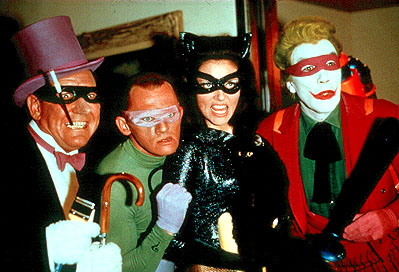
Batman is probably the most well-known entry on the list, a 1966 film based on the popular cheese-fest TV series (which is actually more clever than many people give it credit as being). The show was a huge hit, but its popularity burned out quickly and it only lasted three seasons (though the half-hour episodes aired twice a week during the first two seasons). As an attempt at promoting the show, a feature film was released in the theaters after the first season using four of the show’s villains–Joker (Cesar Romero), Penguin (Burgess Meredith), Riddler (Frank Gorshin) and Catwoman (Lee Meriwether replacing Julie Newmar). The movie introduced the Batcopter, Batcycle, and Batboat (not to mention an exploding shark and bat shark repellent). It received surprisingly good reviews and has enjoyed a long life, and is now available on Blu-Ray.

The Munsters

Munsters Go Home – 1966

Like The Addams Family, The Munsters was a sitcom that premiered in 1964 about a monster-themed family–in this case, the characters were based on Universal’s movie monsters Frankenstein’s creature (Herman), Dracula (Grandpa and Lily), and the Wolf Man (Eddie). While only lasting two seasons with 70 episodes, The Munsters had an enduring impact with multiple versions in various mediums (including an upcoming reboot produced by Bryan Singer and Bryan Fuller that is reported as being an hour-long drama with Eddie Izzard as Grandpa). The first spin-off was the 1966 feature film Munsters Go Home, which was shot in color and was released in the theaters a month after the TV series ended its run. It featured most of the original cast, with the exception of the character of Marilyn (Beverly Owens was considered too old and Debbie Watson replaced her). While this was the only theatrical appearance of the Munster clan, they returned in a number of TV movies and TV shows (both live action and animated) with the original cast and replacement actors.

Peter Gunn

Gunn – 1967

Peter Gunn was a jazzy private eye series created by Blake Edwards of The Pink Panther fame that ran on NBC from 1958-60 and then switched to ABC for the 1960-61 season. It was nominated for eight Emmys and won two Grammys for composer Henry Mancini. Craig Stevens played the classy detective who did his investigating around a jazz club, and the music became a primary characteristic of the series. Six years after the series went off the air, Blake Edwards revisited the character, this time with a feature film written by The Exorcist‘s William Peter Blatty. Gunn hit the theaters in 1967 and died a quick death.

Dark Shadows

House of Dark Shadows – 1970; Night of Dark Shadows – 1971

No other soap opera created such a cult following as Dark Shadows, which ABC broadcast from 1966-71. Dan Curtis’s gothic creation told the story of the Collins family and their supernatural shenanigans in Collinwood, ME. The show really took off when vampire Barnabas Collins was introduced a year into the series run, and by the time it went off the air, characters included ghosts, witches, werewolves, zombies, and warlocks in stories about time travel and parallel universes. A remake series aired on NBC in 1991 and a second attempt for the WB was made in 2004, but was never picked up. Tim Burton directed a feature film version due out this year with Johnny Depp taking over for Jonathan Frid as Barnabas. What is not widely known is that two previous theatrical films were made. House of Dark Shadows was released in 1970 while the TV series was still in its prime. It’s plot, which was apparently independent from the TV series even though it featured the same cast (using the parallel universe ploy), was about Barnabas searching for a cure for his vampirism, though is apparently killed at the end (though an after-credit scene shows otherwise). Featuring more bloody violence than was allowed on television, the film did well enough to warrant a sequel, which came out in 1971. Jonathan Frid did not return for Night of Dark Shadows, which instead focused on Quentin Collins who is possessed by the ghost of ancestor Charles. The second movie was not a success, so that was the end of the Collins family–until the remakes.

H.R. Pufnstuf

Pufnstuf – 1970

Sid and Marty Kroft were heroes to children growing up in the ’70s, creating some magical (some might some hallucinatory) fantasies using puppets and actors in outlandish costumes. The first TV series that they created (after working on The Banana Splits Adventure Hour) was H.R. Pufnstuf, about 12-year-old Jimmy (played by 18-year-old Jack Wild) taking refuge on Living Island under the protection of the dragon Mayor Pufnstuf while being pursued by Witchiepoo (Billie Hayes), who is after Jimmy’s talking flute Freddie. A year into the show’s three-year trip, Universal Pictures and Kellogg’s Cereal pressured the Krofts into producing a theatrical movie that told the story of how Jimmy initially came to Living Island. Pufnstuf was a musical with songs by Charles Fox and Norman Gimbel, and featured Mama Cass and Martha Raye in the cast. While some of scenes were filmed on location, Living Island ironically was shot on the TV series set, composed of flat cardboard backdrops. Considering the audience was either young children or people too impaired to care, that didn’t matter much.

Get Smart

The Nude Bomb – 1980

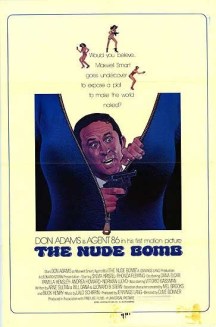
Mel Brooks and Buck Henry created Get Smart in 1965 as a satire to the James Bond movies and the growing number of spy TV series hitting the airwaves during that era. The comedy was an instant hit and won seven Emmys in its five seasons, though like other entries on this list, switched networks in its final season from NBC to CBS. It took a decade for Don Adams to revisit Maxwell Smart with the motion picture The Nude Bomb (later redubbed The Return of Maxwell Smart for TV broadcast) came out in 1980. With the exception of Robert Karvelas as Larrabee, absolutely no one else associated with Get Smart worked on the film; even Agent 99 (Barbara Feldon), who had married Max in the series, was never mentioned. This unfunny comedy lived up to its name and bombed, and even ended up nominated for a Golden Raspberry. It was completely ignored by the 1989 TV reunion movie Get Smart Again! that brought back most of the actors from the series and was actually funny. That was followed up by a short-lived revival (with Andy Dick as Max’s son) and a successful theatrical remake with Steve Carell and Anne Hathaway in 2008.

Honorable Mention: The Monkees

Head – 1968

Like many TV shows made in the ’60’s, The Monkees had a longer cultural impact than its two season would imply. Inspired by The Beatles’s film A Hard Day’s Night, the show’s creators (including future filmmakers Bob Rafelson and Paul Mazursky) created a sitcom about a zany four-member boy band. They cast the roles, thereby creating a musical group specifically for the series, which aired on NBC from 1966-68 and won two Emmys. As a group, the Monkees recorded eleven albums between 1966 and 1966, and toured at various times with and without either Michael Nesmith or Peter Tork. After the TV series was canceled, Rafelson decided to make a film with the group, but it is not really associated with the television show (other than making fun of the theme song) and is a stark contrast to the tone of the show, which is why it doesn’t exactly belong on this list. Co-written by Jack Nicholson, Head involves the Monkees in several unrelated episodes which indicate that their lives are actually being filmed as part of a movie, thereby putting into question free will. The movie had mixed reviews, but found no audience other than ultimately a cult following.

© 2012 Jamie Helton